Why orthodontists are bringing aligner production in-house
Clear aligners are among the most requested orthodontic treatments worldwide — but outsourcing every case to a third-party lab means thin margins, multi-week turnaround and limited control over treatment design.
In-office aligner production changes that. By fabricating clear aligners under your own roof, from digital treatment plan to finished appliance, you replace €1,500–€2,000+ in per-case lab fees with a per-aligner cost as low as €8–€15. You also gain same-day or next-day turnaround, the ability to reprint a lost aligner in minutes, and full clinical control over staging, attachments and overcorrection.
For practices already running a 3D printer for models or retainers, in-house aligner production is a natural next step. Here is the workflow, what it costs, and what to plan for.
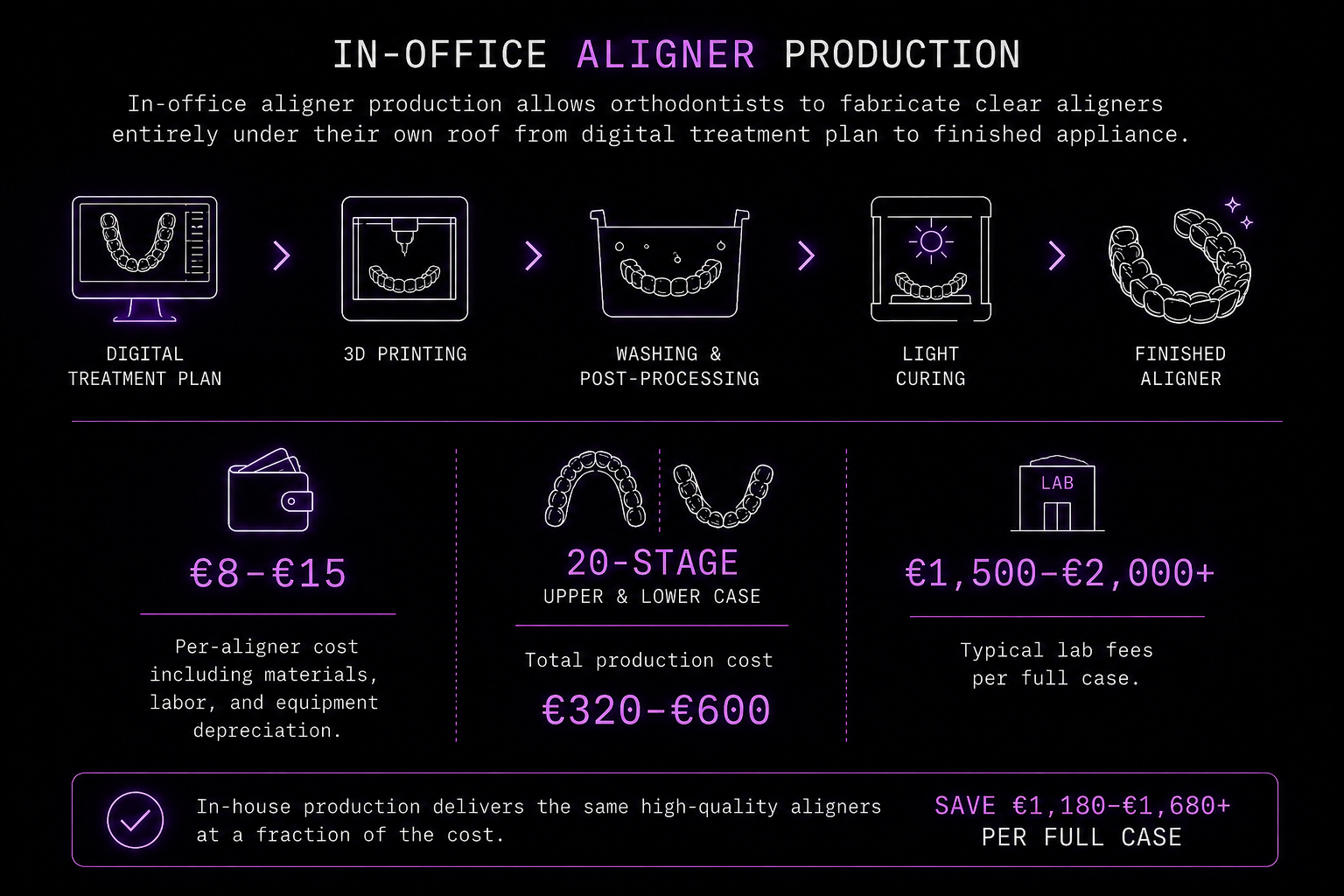
The in-office aligner workflow: 7 steps
In-office (thermoformed) aligner production follows a consistent sequence:
- Treatment planning — stage tooth movements, design attachments and overcorrections, export numbered STL files. This is the clinical brain of the operation.
- 3D printing — print dental models on a resin printer (SLA or DLP) at the sub-100-micron accuracy well-fitting aligners require.
- Resin selection — a model resin optimized for dimensional accuracy and smooth surfaces.
- Post-processing — wash off uncured resin, then UV-cure to full polymerization.
- Thermoforming — press a heated thermoplastic sheet over the model to form the aligner shell.
- Trimming and finishing — cut to the gingival margin and polish to a smooth, comfortable edge.
- Packaging and delivery — label, package and present each stage professionally.
Each step has its own equipment choices, parameters and quality-control checkpoints. The complete setup guide breaks down every step — printer and resin options, machine settings, trimming methods and SOPs — in full detail.
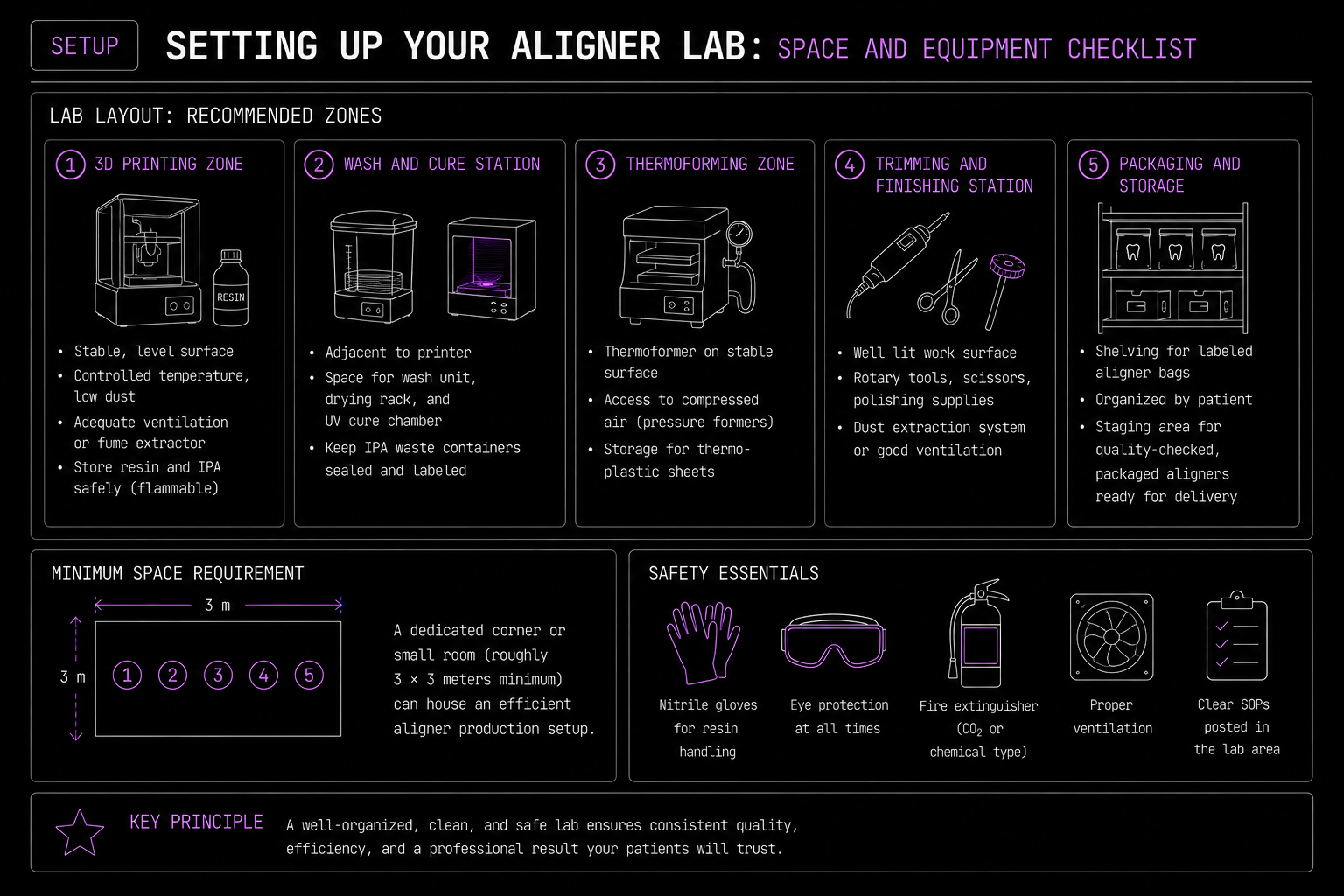
Setting up your aligner lab
You do not need a large space: a dedicated 3 × 3 meter area can house a printing zone, a wash-and-cure station, a thermoforming zone, a trimming station and packaging shelving. What matters is organizing functional zones, managing resin safety and ventilation, and building SOPs so production runs smoothly without constant orthodontist involvement.
What does in-office aligner production cost?
This is the question that decides whether in-house production makes sense for your practice — so here is the bottom line.
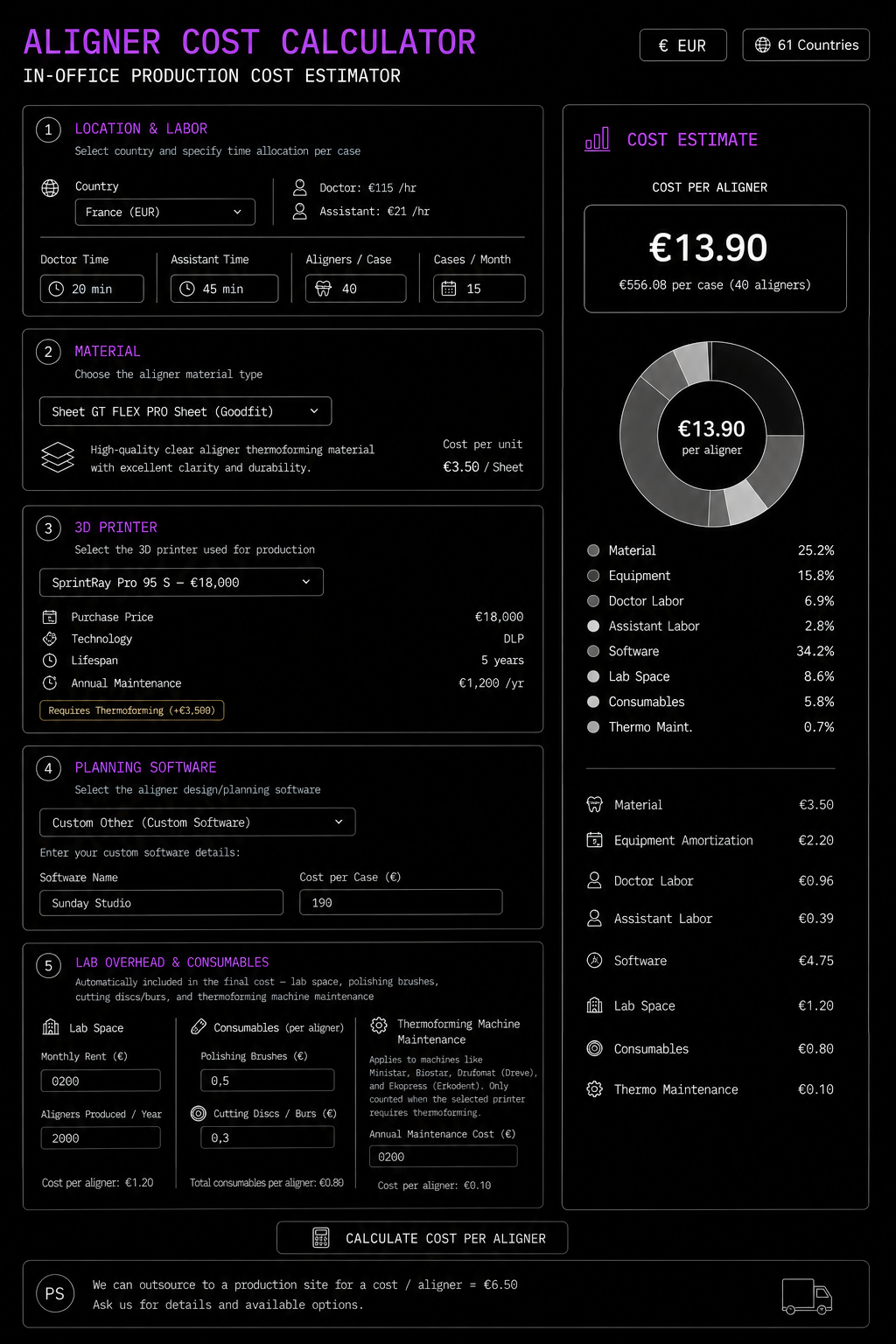
Modeling a representative French practice at moderate volume, with treatment planning outsourced to Sunday Studio at €190 per case all-inclusive, in-office production comes out to roughly €13.90 per aligner — a fraction of the €1,500–€2,000+ in lab fees the same case costs when outsourced.
The full cost math — every input assumption, the per-aligner and per-case breakdown tables, equipment amortization, and how the outsourced-planning line compares to doing the digital setup in-house — is laid out step by step in the complete guide.
Direct-printed aligners: what is coming next and everything you need to plan for
Direct 3D printing of aligners — skipping both the model and the thermoforming step — is maturing fast. Specialized flexible resins from companies such as LuxCreo and Graphy let you print the aligner itself.
It is not yet the mainstream standard, but any practice setting up now should keep its infrastructure compatible with direct printing. The guide covers where direct-print aligners stand in 2026 and how to plan for the transition.
Common mistakes to avoid
The most frequent missteps when starting in-house production:
- Underestimating treatment planning — the clinical brain of the workflow, not a CAD chore.
- Underestimating the trimming step — where comfort and fit are won or lost.
- Neglecting professional packaging — patients perceive the appliance through its presentation.
- Not tracking real per-aligner costs — the only way to know whether the business case is actually working.
- Tackling complex 30-stage cases before the workflow is dialed in.
The complete guide explains how to avoid each one — download it below.
Where treatment planning fits — and how Sunday Studio helps
In-office production gives you control over fabrication. But the most time-consuming and clinically critical step — the digital treatment plan — happens before anything is printed, and it takes 2–4 hours per case.
Sunday Studio is a design-only service built for this workflow. You send your intraoral scans and prescription; your plan is designed by an orthodontist, not a CAD technician, and reviewed within a team of three orthodontists, with staged STL files delivered within 48 hours at €190 per case, all-inclusive. You keep production, delivery and the patient relationship — Sunday Studio simply removes the planning bottleneck.
In-office aligner production FAQ
More questions — staffing, regulation, printing both arches in one run — are answered in the complete guide.