Palatal expander · Hyrax
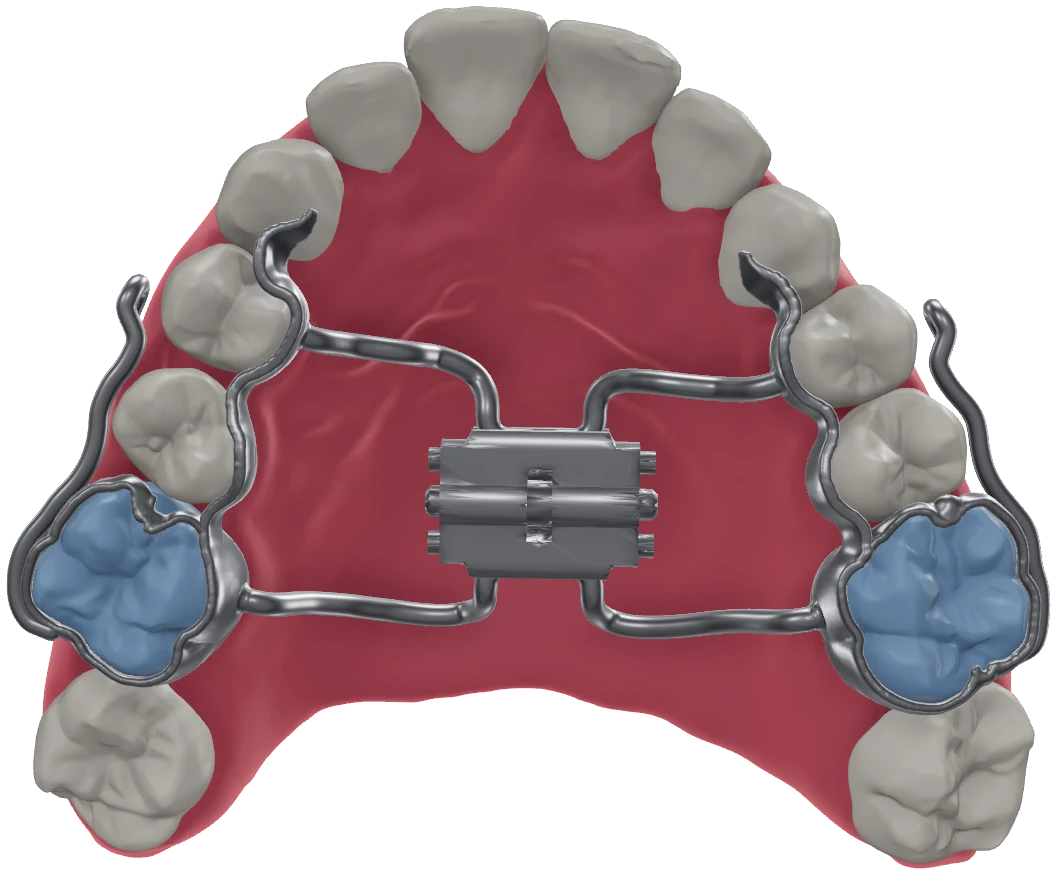
Rapid palatal expander design.
Anatomical. Protocol-based.
Built component by component, each one protocol-based and adjustable. A few minutes per case, nothing drawn by hand.
Runs in your browser. Nothing to install.
How it works
Built step by step,
in a few minutes.
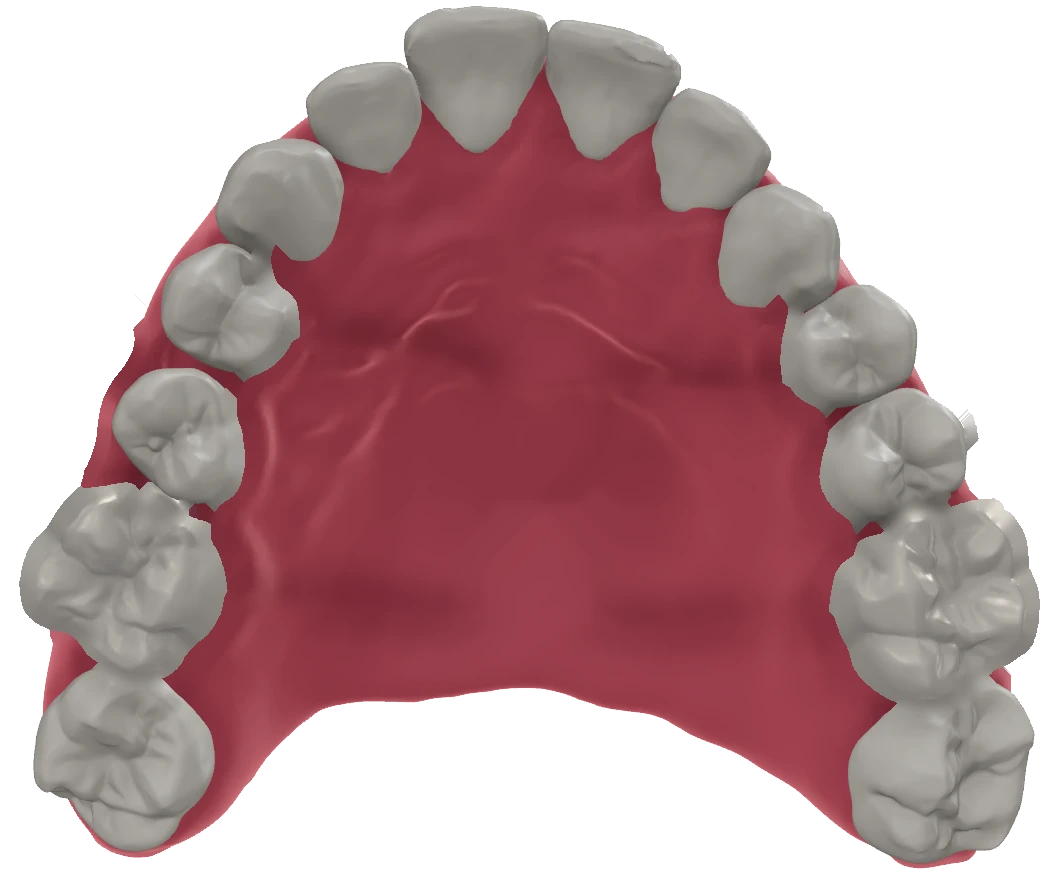
Upload the scan
Segmented upper arch, from any scanner
Build step by step
One component per step, from predefined settings
Adjust what you want
Gizmo, beads, sides, heights, in 3D
Print the framework
Co-Cr, in-house or at your partner lab
Bands and anchorage
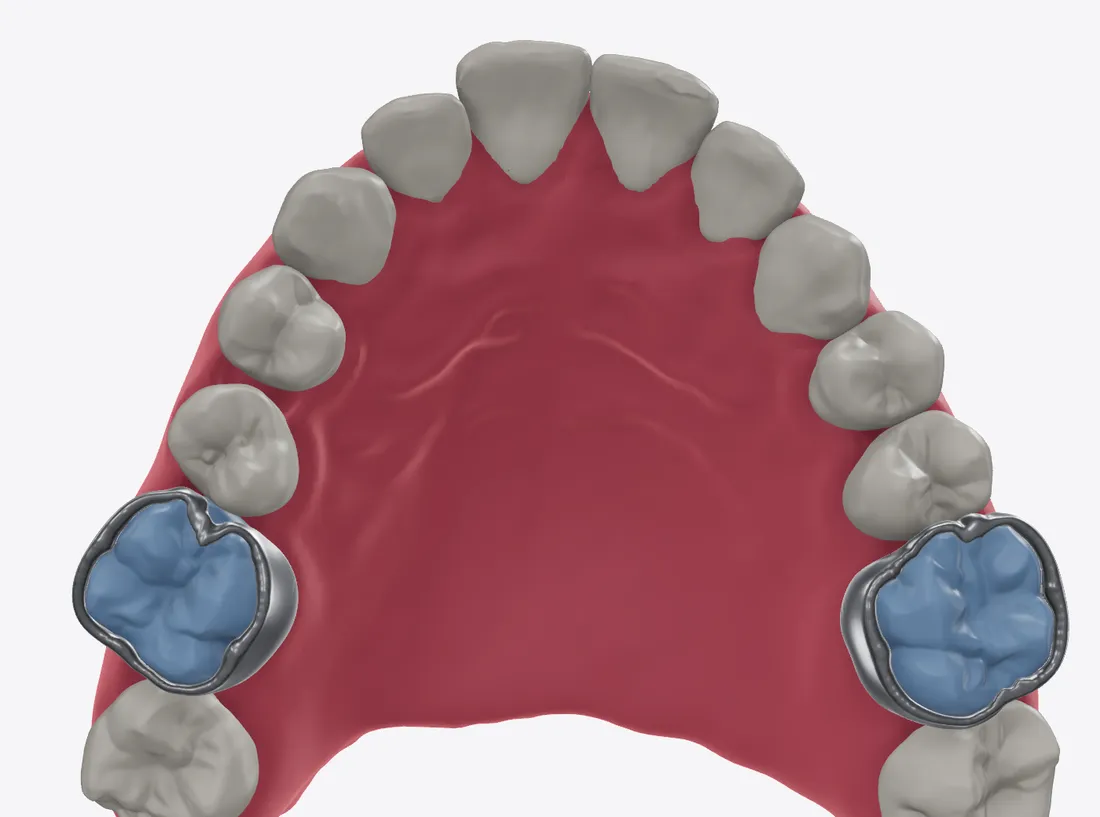
Anatomical bands, by dentition.
Tooth-borne anchorage: the screw force reaches the suture through the banded molars. Hyrax and Haas-type expanders gave similar skeletal effects; the acrylic-borne design tilted the premolars more.
Mixed dentition · 55 and 65
Bands on the second deciduous molars, palatal arms on 53 and 63. Expansion anchored on deciduous teeth widened the arch in the early mixed dentition and spared the permanent teeth.
Permanent dentition · 16 and 26
Bands on the first molars from 12 years. Two-band expansion lost its skeletal effect beyond 12 years; four-point anchorage with 14 and 24 was age-independent and opened the suture 2.5 times more.
Anatomical band
Built on the scanned crown with a 0.05 mm cement gap. A laser-melted Co-Cr framework fits without prefabricated sizing.
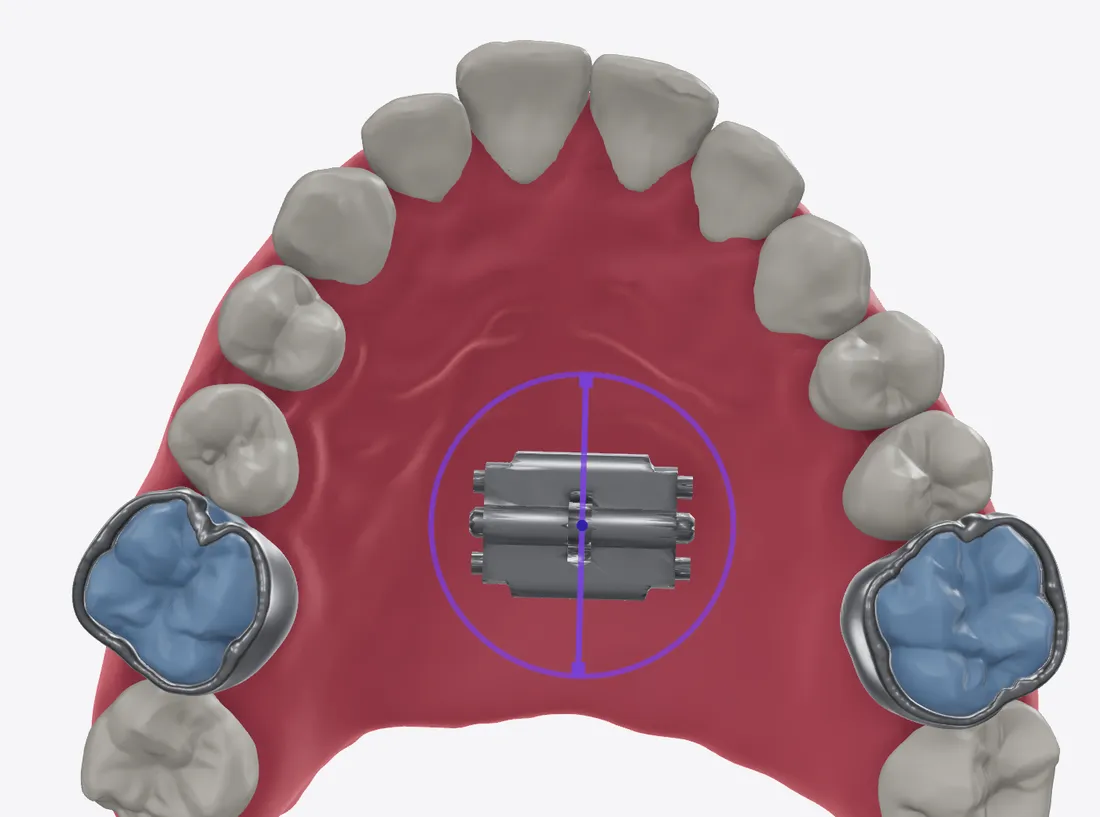
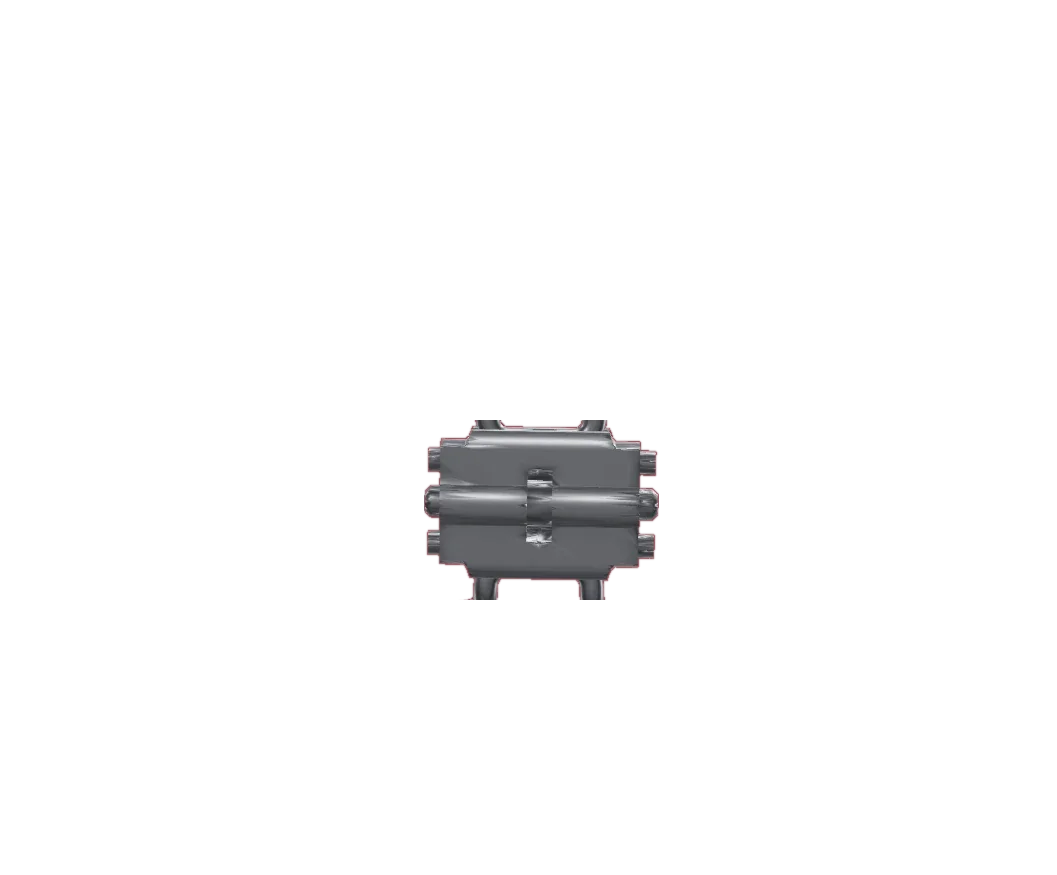
Screw position
At the maxilla’s
centre of resistance.
The two maxillary halves rotate around a centre near the frontonasal suture: the lower the force, the more they tip. The screw sits as close to the centre of resistance as the palate allows.
Height
4 to 5 mm beyond the palatal CEJ, parallel to the occlusal plane. Screw height changes the molar tipping pattern (finite element study).
Centred on the raphe
Within 0.3 mm of the midpalatal suture, so both halves receive the same force. The suture opened in every growing subject, 1.6 to 4.3 mm anteriorly.
Clear of the mucosa
The screw body never bears on the palate. Adjustable with the gizmo, read in the frontal view.
Connectors
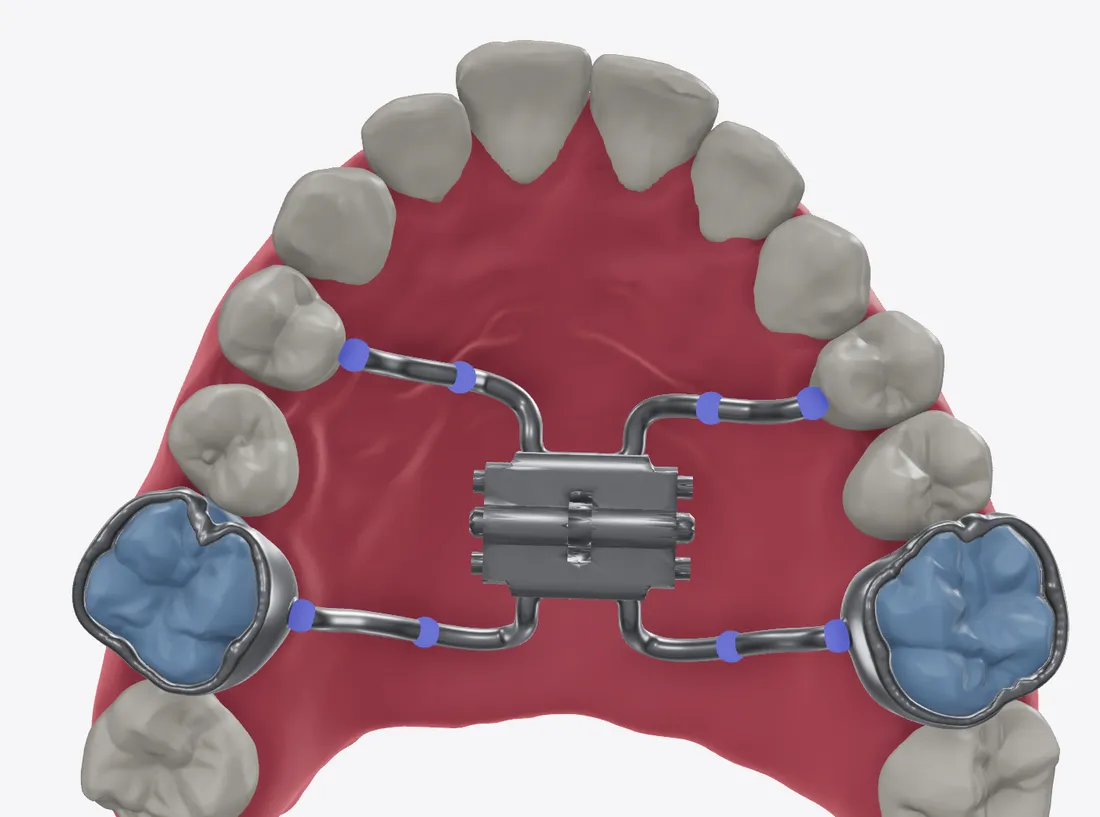
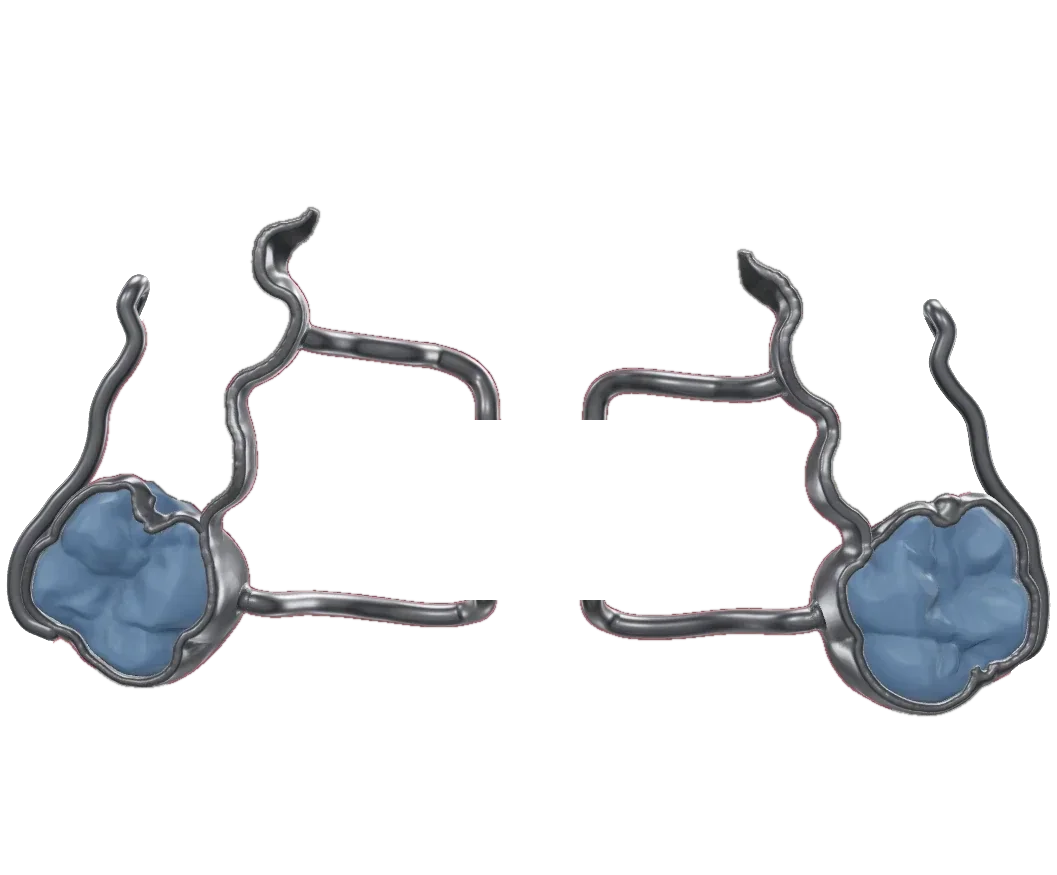
Two or four connectors.
Two connectors in the young patient, a compact body. Four connectors from 12 years, to the premolars, where the suture resists more and the anchorage has to be spread.
Two connectors
Mixed dentition, mild crowding: a two-band design is enough and less bulky; its skeletal effect fails beyond 12 years. A compact screw body gave the same dental effects as a standard Hyrax in adolescents.
Four connectors
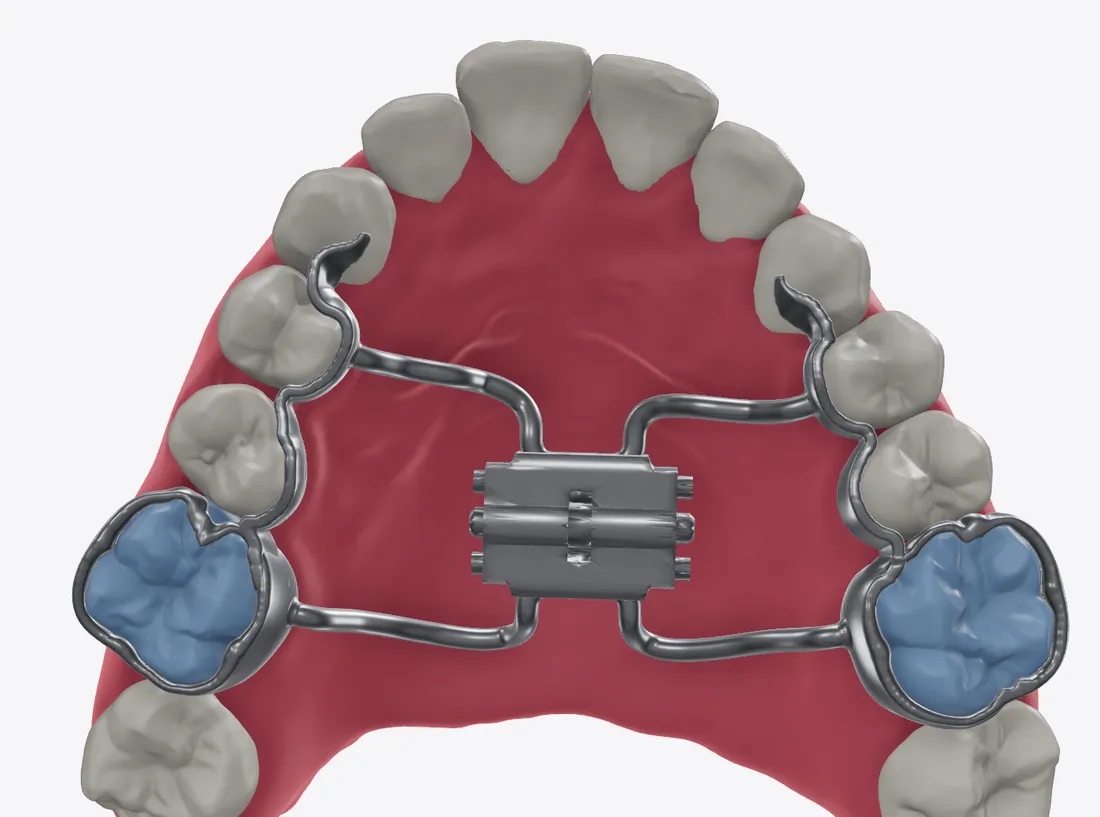
From 12 years, severe crowding or beyond 7 mm of expansion: four-point anchorage with 14 and 24, heavier arms.
Section
Oval section, 1.5 mm round wire or more. The wires joining the teeth to the screw should be as thick as possible; acrylic lacks rigidity and lets the halves tip.
Palatal arms
Palatal arms,
premolar or canine.
Bonded on the premolars or extended to the canines, the palatal arms spread the load on more teeth. Anchored teeth tip during expansion and upright in the long term, without periodontal loss.
Premolars · 14-15, 24-25
From 12 years, the arms end on the premolars: the four-point design of the permanent dentition.
Canines · 53, 63
In the mixed dentition, bonded on the deciduous canines, the permanent teeth stay free.
Ribbon or normal
Ribbon section, height and thickness in mm, bonded on the palatal surface. Anchorage teeth lose 0.6 to 0.9 mm of buccal bone during expansion: more supporting teeth, less load on each.
Auxiliaries
Auxiliaries, in the same framework.
Chosen with the expander, built in the same case, printed in the same part.
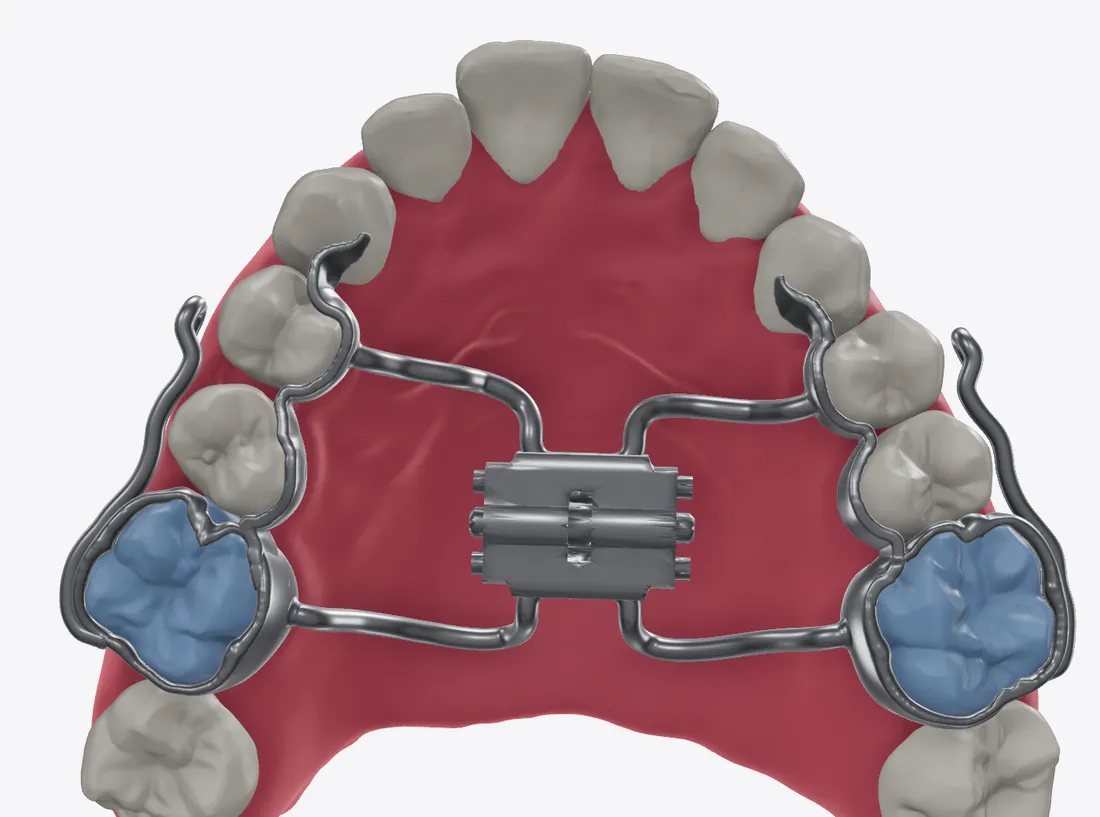
Facemask hooks
Expansion before protraction. The Alt-RAMEC protocol produced 3.0 mm of maxillary advancement at A point against 1.6 mm after a single expansion, in cleft patients.
Liou & Tsai, Cleft Palate Craniofac J 2005.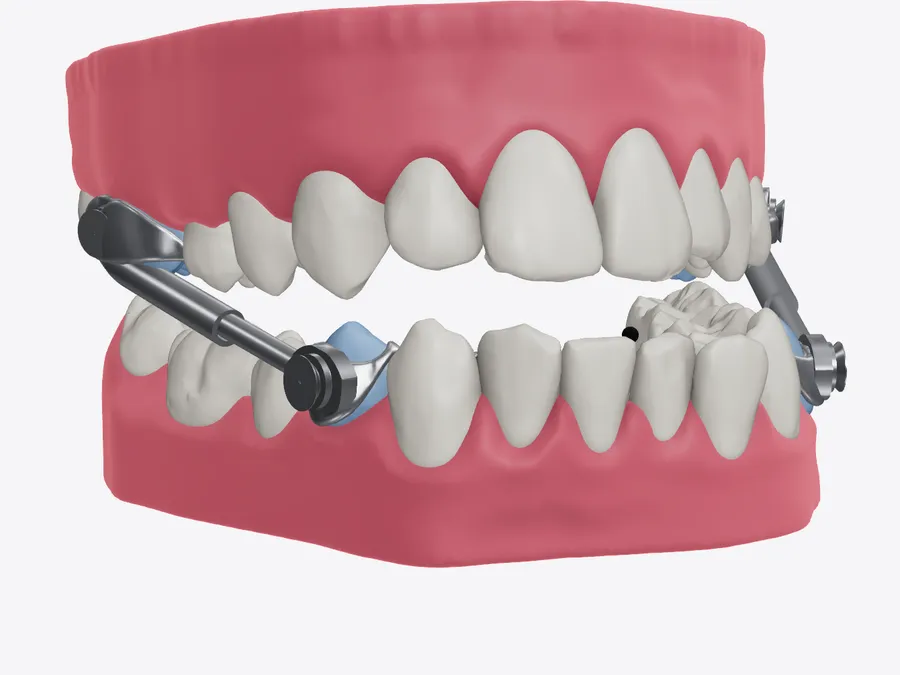
Herbst pivots
Herbst on the expander bands. Started at the peak height velocity, the condylar growth response was greatest and the retention shortest, in 70 consecutive cases.
Pancherz & Hägg, Am J Orthod 1985.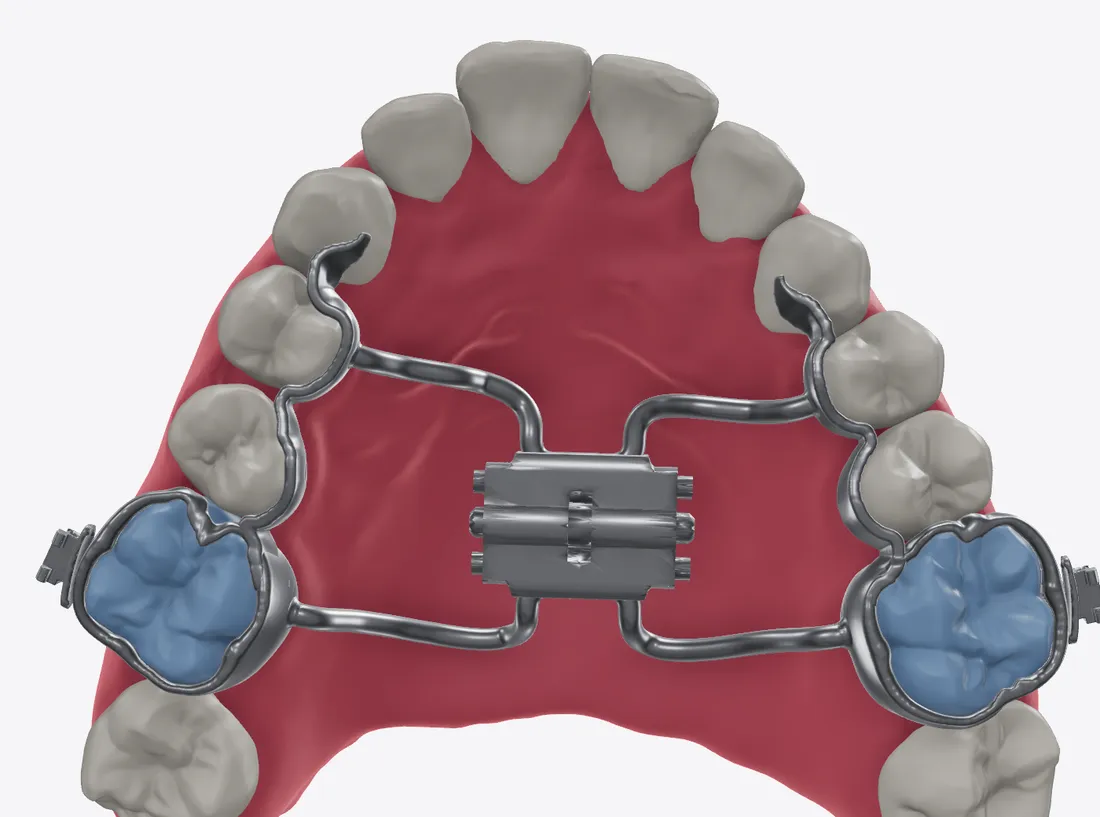
Molar tubes
Tubes on the bands, MBT or Roth, .018 or .022. The fixed appliance starts during the retention of the expansion.
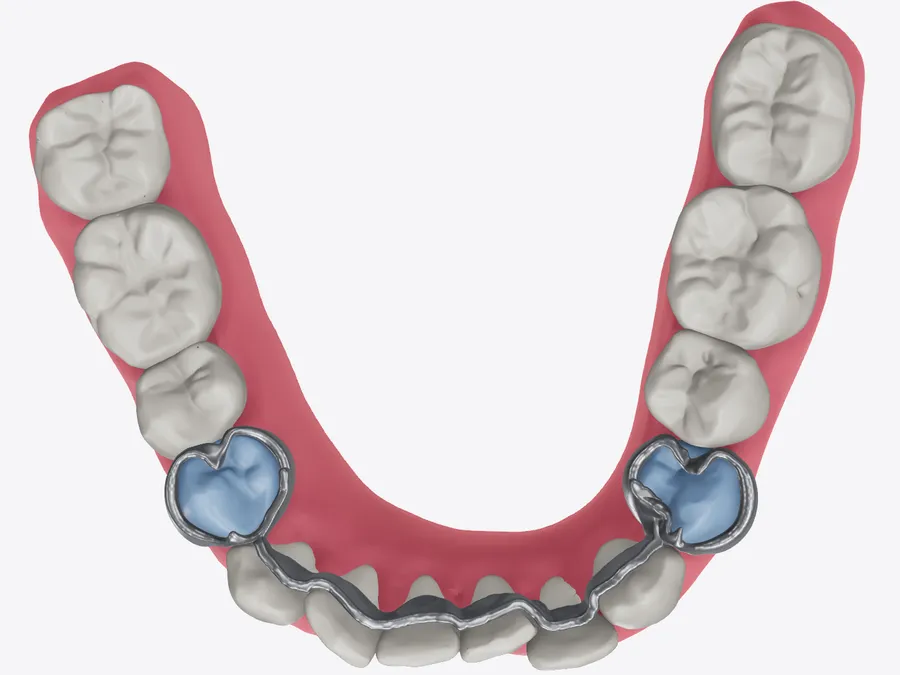
Lingual arch
Lower lingual arch in the mixed dentition. It held arch length within 0.4 mm and resolved incisor crowding in 60 % of 107 patients.
Brennan & Gianelly, Am J Orthod Dentofacial Orthop 2000.Print-ready
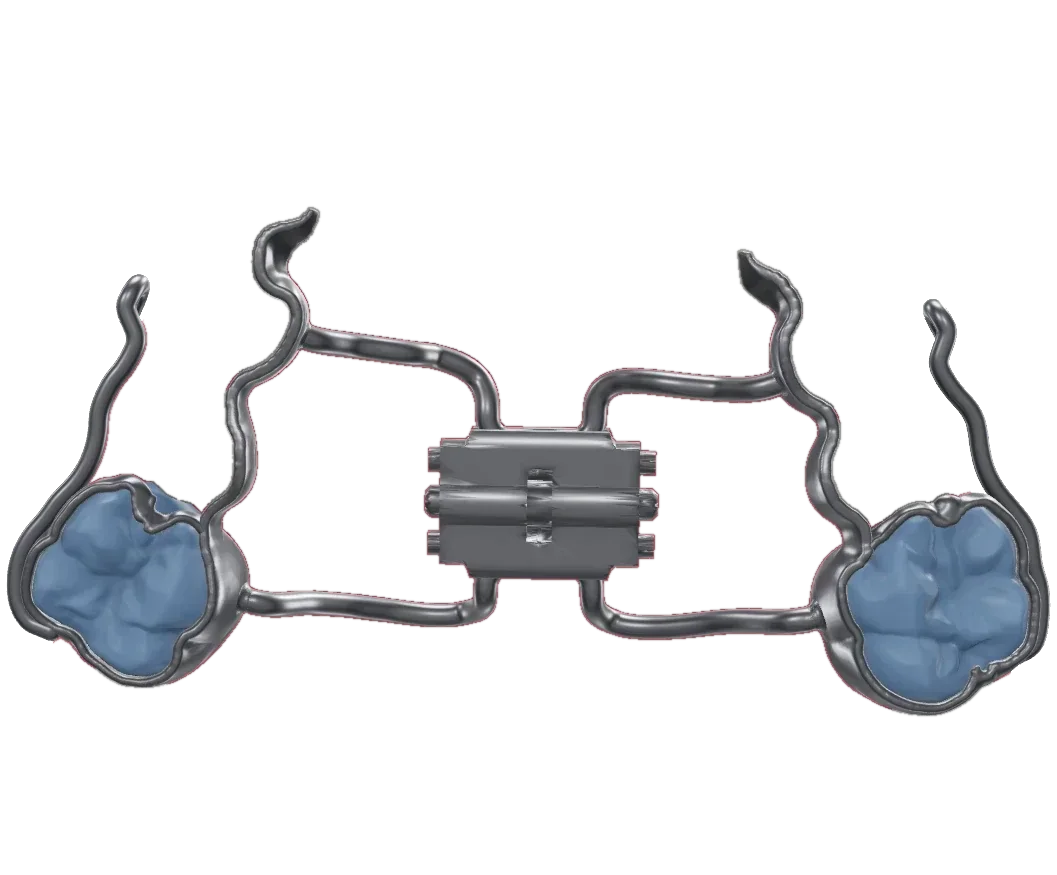
One framework, printed in Co-Cr.
One print-ready STL, support bars and case ID built in, with the working model and the appliance sheet. Print in-house or at your partner lab, weld the screw into its seat.
- One Co-Cr monobloc
- Support bars built in
- Screw welded in its seat
Biomechanics
Rapid palatal expansion, in six notions.
What the literature says about the suture, the forces and the teeth. One or two sentences per notion, with its source.
Sutural opening
The suture opens parallel in the anteroposterior direction and triangular in the vertical, apex towards the nasal cavity. It opened in every growing subject, 1.6 to 4.3 mm anteriorly.
Haas, Am J Orthod 1970 · Lione et al., Angle Orthod 2013.Skeletal share
In the long term, the skeletal transverse gain is about a quarter of the dental expansion in prepubertal adolescents. The rest is tipping and alveolar bending.
Lagravère et al., Angle Orthod 2005, systematic review.Timing
Expansion before the pubertal growth peak, staged on the cervical vertebrae, gives greater skeletal transverse changes. After the peak, more of the expansion is dental.
Baccetti et al., Angle Orthod 2001.Protocol
Rapid expansion, two quarter turns a day, and slow expansion both widen the maxillary arch. Alt-RAMEC alternates expansion and constriction weekly for 7 to 9 weeks before protraction.
Zhou et al., Eur J Orthod 2014, meta-analysis · Liou & Tsai, Cleft Palate Craniofac J 2005.Periodontal effects
The buccal bone of anchorage teeth thinned by 0.6 to 0.9 mm and the lingual plate thickened by 0.8 to 1.3 mm. Anchored teeth tip, then upright; the periodontium was not compromised in the long term.
Garib et al., Am J Orthod Dentofacial Orthop 2006 · Lione et al., Angle Orthod 2013.Vertical and sagittal
The maxilla moves slightly downward at the end of expansion; the change is small and transitory. In the long term, expansion does not change the facial growth pattern.
Lione et al., Angle Orthod 2013 · Lagravère et al., Angle Orthod 2005.FAQ
Common questions about expanders.
Design your first expander.
Start your free trial. 30-minute live onboarding included, we design your first case with you.
Contact
Reply within one business day